
Choose the part to reconstruct
A clip can include setup, inspection, and time after the solve. Mark the first and last turn to tell solve.vision where to look.
Former world-record average · Beijing Winter 2026
Loading the example report…
| Phase | Time / s | Recognition / s | Execution / s | Turns | TPS |
|---|
Xuanyi Geng · Beijing Winter 2026
Known scrambles. All five move sequences match the published reconstructions. Timing: approximately ±100 ms. Cube rotations and solver viewpoint are estimated; orientation is held where tracking is missing.
 Ignore
Inspection · Solve · Finish
A clip can include setup, inspection, and time after the solve. Mark the first and last turn to tell solve.vision where to look.
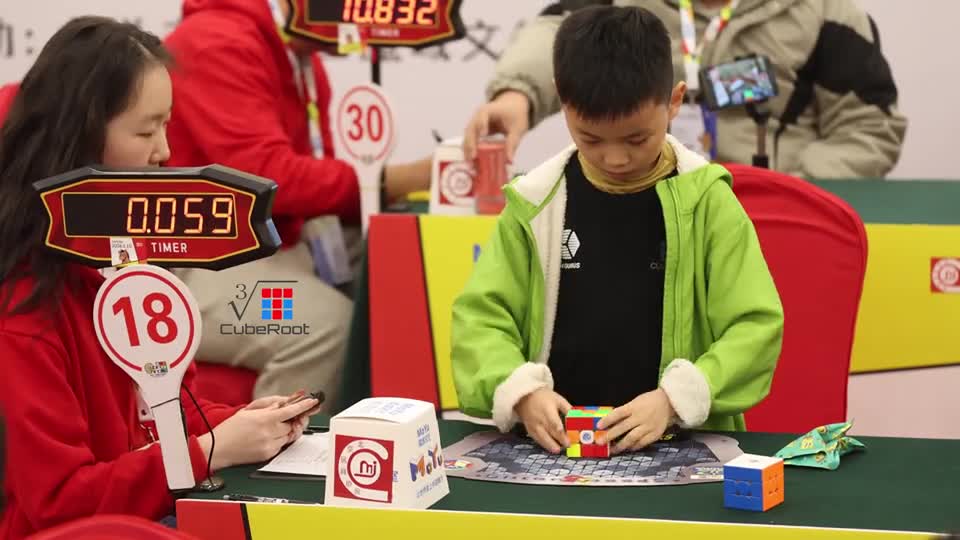
Spare cubes on the table can distract the detector. Draw a box over them and check that your solving cube stays outside it.
Keep the first and last moves in frame. 50 or 60 fps helps with fast solves; top-down and front views both work when the stickers are visible.
No. The reconstruction uses the video of a regular 3×3.
No—the example above uses a wider competition shot. What matters is whether the stickers are readable. Hands hiding the cube, especially from the side, make reconstruction harder.
No. Reconstruction can fail or return an incomplete result, even with a video that looks clear. Camera angle, motion blur, lighting, and hands hiding the stickers all affect the result. The five examples above are successful reconstructions, not a guarantee for other recordings.
Yes. Upload your video, mark the first and last turn, optionally mask extra cubes, and submit it for reconstruction. When processing finishes, you can view the result in your solve report.